A recap of the Ar-Kaïm rules from 3e
Ar-Kaïm were first teased in a first edition accessory as a rumor of “astrological Nephilim” and formally revealed in late second edition metaplot. In the adventure path Chroniques de l'Apocalypse (“Chronicles of the Apocalypse”), Akhenaton revealed their existence to the Nephilim leaders at the Grand Conclave in 1999.
However, they were only named as “Ar-Kaïm” and given concrete rules in third edition, titled Nephilim: Revelation. They were an option for PCs alongside Nephilim and Selenim, with the option for mixed or homogenous groups. Additional rules were provided in their respective splatbook, Codex des Ar-Kaïm (“Codex of the Ar-Kaïm”). No playable rules have since been provided in subsequent editions.
The name Ar-Kaïm is Enochian and was given to them by the Horsemen of the Apocalypse. It means “the new Kaïm”. This refers to how, after the fall of Orichalka, only Ar-Kaïm were born from the magic fields. Although the Nephilim are seemingly numerous, they are a steadily dying race.
The Ar-Kaïm’s place in the universe of Nephilim is vague and inconsistent. The writers seemingly could not come to an agreement about how to handle them, so published materials and interviews from the 2000s are contradictory.
In the first and second editions, it was vague as to whether Nephilim were still being born or not after the fall of Orichalka. Various artificial and mutant Nephilim characters were introduced sporadically, such as Jesus, Guinevere, and The Beast. The late second edition book Le Ka finally confirmed that Nephilim were no longer born, only Ar-Kaïm. Many of these were speculated or confirmed as being early examples of Ar-Kaïm in their respective codex. (The Multisim site released conversion notes for a number of supplements that confirmed The Beast was an Ar-Kaïm of Serpentarius.)
Initially, third edition claimed Ar-Kaïm started appearing as of 1900 due to Crowley’s experiments on the magic fields, with the oldest known one being a character named Louis featured in an official webzine adventure path (sadly unfinished). In subsequent books, Codex des Ar-Kaïm, Les Bohémiens, and Les Atlantéides, they were explained as having been born starting all the way back in Atlantis, albeit extremely rare until the Revelation of 1900, and their existence was concealed by the Bohemians.
After Nephilim: Revelation was canceled due to Multisim’s bankruptcy, the writers worked on a prequel game about the medieval period that would have featured precursors to the Ar-Kaïm. (This contradicts the statement about them being present for millennia.) These precursors would have included primitive awakened humans and living incarnations of archetypes.
In the fifth edition, the writers seemingly gave up due to lack of interest. The Ar-Kaïm were described as having largely vanished after 2012 for unknown reasons, with a handful of NPCs being present in the hidden magical city of Arcadia.
I recap the overarching structure of the 3e revisions here. I have divided this post into Initiation, Aspect, Occult Path, Past, Downfalls, and Other details, mimicking the structure of character creation.
Initiation
Instead of a Pentacle of 5 Ka-elements like Nephilim, Ar-Kaïm have a Heart that contains 2 to 8 Kas. These consist of a Dominant Ka and “other” Kas that cannot exceed their former, all measured as Characteristics with levels and points. If they have three or more Kas, then one is always Orichalc. Their Solar-Ka "sublimates" their Kas to bring it close together, while their Orichalc "softens" their Kas so that it mixes together. As such, Ar-Kaïm are not allergic to Orichalc like Nephilim are.
Ar-Kaïm use their Kas as pools of magic points. Each Ka has both a permanent rating and a temporary rating. They regain Ka points through spontaneous charge based on the daily astrology, through analogical charge by engaging in acts symbolic of that Ka, and through magical charge by siphoning Ka points from magical items and places.
The Kas manifest minor physical effects in the surrounding environment, similar to Nephilim’s metamorphoses. The amount of Ka points determine the visibility for the purposes of occult spies detecting it.
However, they must take care to keep their Heart balanced or risk Instability. They must keep the temporary values of their Kas within a certain threshold of each other, and they should not exceed their permanent ratings. If an Ar-Kaïm isn't careful then they can explode, thus ending their quest prematurely and permanently.
If a Ka’s temporary rating ever fell to 0, then it would vanish from the character’s Heart. There was seemingly no way to restore it in the rulebook. (The rules for adding new Kas to the Heart were introduced in Codex des Ar-Kaïm as part of an occult path/quest unique to the Ar-Kaïm: the Path of the Ascendant.) If their any of their Dominant Ka, Solar-Ka or Orichalc pools ever fell to 0, then their Heart explodes.
Managing the Ka pools in play was thus quite convoluted. The rulebook suggests using sets of colored chips to track each Ka.
Aspect
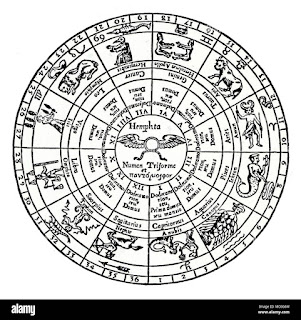
Ar-Kaïm have a Dominant Ka but, instead of the five humors and associated metamorphoses like the Nephilim, they are styled after the Zodiac. There are twelve Houses of the Zodiac plus the “hidden” thirteenth house of Serpentarius (called Ophiuchus in modern English astrology). The five elements have two Houses each, while Solar-Ka, Orichalc and Black Moon-Ka only have one each.
Air, element of Jupiter, is the Dominant Ka of Pisces and Sagittarius. Earth, element of Venus, is the Dominant Ka of Libra and Taurus. Fire, element of Mars, is the Dominant Ka of Aries and Scorpio. Water, element of Mercury, is the Dominant Ka of Gemini and Virgo. Moon is the Dominant Ka of Cancer and Capricorn. Solar-Ka is the Dominant Ka of Leo. Orichalc is the Dominant Ka of Aquarius. Black Moon is the Dominant Ka of Serpentarius.
Each House has it own personality stereotypes associated with it, but this is purely fluff and PCs are not forced or encouraged to act in any particular way. Unlike metamorphoses, these have no effect on an Ar-Kaïm’s appearance or aura. The exception is if the character is suffering from Chaotic Khaiba, which causes their body to take on the form of their zodiac sign.
These personality stereotypes contradict the rules for recharging Ka by performing sympathetic actions. These actions are determined by the Ka involved, not the Zodiac sign. So characters may be forced to perform actions that don't suit their personality in order to recharge. For example, a Leo with the personality stereotype of being a proud inspiring leader will find himself spray painting a church in order to recharge his Black Moon or Orichalc pools.
Occult Path
The Ar-Kaïm do not practice Occult Sciences as such. Instead, they have Talents. These are essentially superpowers, and each is ranked with its own skill level. The skill level affects how easy it is to exercise a Talent. As the skill level increases, so does the power and scope of the effect. The player may always use the lower level version of the effect, if desired.
Their House determines how easy it is to learn and use their Talents. Each House has eight Talents linked to it, one for each Ka. A member of a House finds it easiest to to learn and use the Talents of their own House, and harder to learn and use those of other Houses.
Talents are divided based on their associated House and Ka. Each Ka has a general function associated with it, which is then expressed through the lens of the Talent's House. Air is linked to the theme of Sensation, Earth to Defense, Fire to Attack, Water to Movement, Moon to Emotion, Orichalc to Magic, Solar to Exaltation, and Black Moon to Dark Side. These functions are purely fluff and not rated as skills or anything like that.
To exercise a Talent, the player rolls the Ar-Kaïm’s Initiated Characteristic + the skill level of that Talent. This roll is not affected by any astrological modifiers. They spend Ka points to power their Talents. It is cheaper to pay with the same Ka as the Talent, but any Ka may be paid with an additional surcharge. The Ar-Kaïm does not require the associated Ka to exercise Talents linked to that Ka. The number of points spend is further adjusted by the astrological conditions, with conducive days and months reducing the cost.
In their splatbook, Codex des Ar-Kaïm, the Ar-Kaïm are given their own special Occult Path. These new paths were cultivated by pursuing a quest unique to the Ar-Kaïm, divided into three steps: the Inner Astral, the Path of the Ascendant, and the Stellar Path. While not an Occult Science, they are able to develop additional Talents, cultivate their own personal mind palace in the astral plane, and introduce new Kas into his Heart. This quest was the subject of the campaign supplement Les Atlantéides, in which the entire party helped an Ar-Kaïm complete the step for the Inner Astral.
As part of this quest the Ar-Kaïm develops a new characteristic known as the “Solar Spine”. This reflects his understanding of his own Solar Spine, an aspect of his Solar-Ka. In the lore, this Spine is the part of the human soul that lets them dream and visit the Akasha. It remains with the corpse after death and is what necromancers manipulate. It doesn’t have a pool like the other Ka and is only rolled for the handful of Talents and Rituals related to the Inner Astral.
The “fourth” Occult Science of Qiyas was teased in late second edition but only introduced rules in the campaign supplement Al-Mugawir. Qiyas can be learned by any character type, but Nephilim and Selenim don't innately utilize Solar-Ka and must fulfill additional prerequisites. As they already incorporate Solar-Ka into their Heart, Ar-Kaïm are well suited to learning Qiyas without fulfilling any other prerequisites. Qiyas is a convoluted magic system that I cannot fully describe here, but the short version is that it is similar to the Nephilim’s Sorcery (particularly the freeform word-based sorcery in the third and fourth editions) and to enlightened white stone alchemy (see Enlightened Magic). Instead of Elements it uses the symbols from Zener cards as its basis of categorizing effects. To summarize the complexity, spells are cast by crafting magical objects and showing them to people.
The House of Serpentarius is closely tied into the origins of the Occult Path of the Atlantides, detailed in the campaign supplement Les Atlantéides (“The Atlantides”). This Occult Path creates a magical oath and bond between the practitioners, known as a Ka-Tet (this term is apparently taken from Stephen King’s The Dark Tower). The members of the Ka-Tet can share their health, knowledge, and magic between each other even across distances. The Ka-Tet is represented by a physical object similar to a Stasis Object and this has its own spirit too.
Oddly, the splatbook Les Bohémiens briefly mentions that it is possible for certain fated Ar-Kaïm to learn Sorcery like Nephilim. This has a few minor caveats but otherwise works normally.
Past
At this step, the player notes his character’s understanding of his dreams, the number of times he has reincarnated, and his knowledge of the occult world. These are three separate sub-sections.
Ar-Kaïm PCs are assumed to have first incarnated sometime in the 1990s to early 2000s, the then-present when the game was released. The incarnation can cause memory loss, resulting in a PC who begins play suffering complete amnesia or only remembers their Simulacrum's dreams. As far as I know, this amnesia is never reflected in the backstory or personality of any Ar-Kaïm characters described in the books. Neither is it ever referenced again by the descriptions of their fluff and quests. I have to assume the writers either forgot this detail or deliberately ignored it after realizing the difficulty it causes.
The Past rating determines extra skills points at character creation, as well as understanding of their own dreams. Their closeness to their Simulacrum affects how sensitive they are to any Akasha Gates, making them ideal for adventures involving Akasha visits. This comprehension is fixed at character creation and cannot be improved, though it can be switched to the Anti-lands or lost completely.
A rule regarding their Understanding of Akashas is that the rulebook assumes it works the same for all Ar-Kaïm. However, their codex introduces inconsistencies. The first is that when Ar-Kaïm develop their Inner Subtle Plane, it is an Anti-land (lower plane) for Serpentaries due to their dominant Ka being Black Moon; likewise, their Astral Talents relate to travel in the Anti-lands. So they have understanding of Akasha but not Anti-land? The second inconsistency is that Ar-Kaïm suffering Khaiba change their understand of Akasha to an understanding of Anti-land, but don't shift their Astral Talents when this happens. A Serpentary would only have understanding of Anti-Land Gates when suffering Khaiba, but never have Akashic Talents! Thirdly, why do these restrictions only apply to Serpentaries due to their Black Moon-Ka but not to Aquarians due to their Dominant Ka being Orichalc?
Although Ar-Kaïm are suggested to have existed in some form for millennia, PCs are generally expected to have first incarnated no earlier than the 20th century. The Golden Dawn's disturbances resulted in the mass incarnation of many Ar-Kaïm and this wave continues into the present. In their Codex, Ar-Kaïm may have one past incarnation for every ~30 year period since 1900, going backwards: 1990–then-present, 1960–1990, 1930–1960, 1900–1930. Their current incarnation is assumed to have started sometime in the then-present 1990s–2000s. The rules don't—can’t—account for any newer periods.
Unlike Nephilim and Selenim, Ar-Kaïm PCs are assumed to be newcomers to the occult world and begin with no known of the secret history or immortal intrigues. The player may decide otherwise by noting levels in Occult Knowledge.
In a writer’s FAQ released early in development on a fansite, it suggested that an Ar-Kaïm PC could be linked to a destroyed Nephilim who was formerly part of another group. This plot device was used to explain how a mixed group of an Ar-Kaïm and other Immortals could experience flashbacks to a shared event. That Nephilim’s Ka dissolved and nourished the Nexus that birthed that Ar-Kaïm. Its memory embedded in whole or part within the Ar-Kaïm’s Heart and resurfaces through flashbacks. That Ar-Kaïm could embark on a quest for this memory… However, this concept was never picked up in any of the books.
In Codex des Ar-Kaïm, an Ar-Kaïm can gain the ability to have flashbacks to the lives of his ancestors. This allows him to learn limited skills from the lives of his prior simulacra (if any) and his first simulacrum’s maternal ancestors, analogous to the past life flashbacks experienced by other Immortals. (This seems to have been inspired by Other Memory from the Dune novels by Frank Herbert, which is a known influence on the French writers.)
Downfalls
Ar-Kaïm are not allergic to Orichalc like Nephilim are: being struck with an Orichalc weapon will harm their Simulacrum, but it won't inflict magic damage on their Heart.
Ar-Kaïm really only have two degenerations: Khaiba similar to Nephilim, and Instability unique to them. Instability is caused by the Ka pools in their Hearts being unbalanced or overloaded. So characters need to take care to avoid imbalances.
At this step of character creation, the player notes the corresponding Downfalls to his previous choices. Similar to other games, balance between PCs of different power levels is maintained by applying an equal amount of flaws. Some Flaws were reserved for Ar-Kaïm PCs, specifically ones related to their unique mechanics like their Talents, their Ka pools, their Simulacrum, and their family.
Curiously, an Ar-Kaïm can be turned into homunculus as explained in the Arcanes Mineurs supplement, but cannot have the Flaw of being a former homunculus. This is probably because those flaws assume the PC has a stasis object, but that could be easily errata’d by specifying the PC must also have the novel stasis object flaw (see below).
Other details
Stasis
Ar-Kaïm normally lack Stasis items and may only take it at character creation as a Downfall. It provides some of the same functionality as that of a Nephilim's: he may track its general direction and distance, it will automatically absorb and preserve his Heart upon death until a relative can release it, and he may tap charges of only the five Elemental Ka. The only real downsides are that he will perish immediately if the Stasis item is broken*, a trapped Heart must be released by a relative, and he cannot tap charges of Solar-Ka, Black Moon or Orichalc.
* In most editions of the French version, a Nephilim will die immediately if their stasis object is broken. This limitation was only removed in the fifth edition, but they still require a stasis object to reincarnate and no rules are provided for replacing it.
Simulacrum
Ar-Kaïm cannot reincarnate as easily as Nephilim. Firstly, their Heart cannot survive disembodiment and perishes along with the Simulacrum. Secondly, they can only reincarnate within an occult dynasty unique to each Heart: those descended from the bloodline of their first incarnation. They must transmigrate their Heart into the new Simulacrum while the old Simulacrum is alive to perform the ritual, which kills the old Simulacrum upon completion. This doesn’t transfer the personality of the previous Simulacrum, so each incarnation is a new person who inherits their predecessor’s Heart.
Ar-Kaïm don't experience Shadow (Shouit). The reason for this is because, unlike the Nephilim, their Heart is not a fallen Kaïm possessing hapless humans as hosts. The Simulacrum's personality is the only one in the body, merging with the Heart upon (re)incarnation. While the Ar-Kaïm retains skills from prior Simulacra, their personalities aren't preserved. Thus, an Ar-Kaïm who fears death raises their successor to display a similar personality.
Unlike the Nephilim and Selenim, Ar-Kaïm are thus dependent on their relatives for their immortality and cannot simply abandon their bloodline if they want to preserve their immortality. The Ritual of Transmigration that allows them to reincarnate seemingly was not invented until about 1900, explaining their extreme rarity prior to that time. They simply could not reincarnate and build occult dynasties until the Age of Revelation.
However, the adventure supplement Les Atlantéides contradicts this with a strange example of an Ar-Kaïm who was killed 10,000 years ago reincarnating within a modern descendant through a Nexus. This resembles the normal "rebirth" of a human into an Ar-Kaïm, except that his new Heart has the personality of his deceased ancestor without any explanation for how this is possible. This might be a unique example or it might be confirmation that there are other ways for Ar-Kaïm to reincarnate.
Another point of oddity comes from the Gamemaster's Book. The rules for third circle Necromancy allow the necromancer to resurrect an Ar-Kaïm whose Heart exploded. The spell specifies that a resurrected Ar-Kaïm no longer has an understanding of his Simulacrum and thus loses his innate understanding of Akasha Gates (see above). However, the rules here don't explain how the Ar-Kaïm gets a new Simulacrum and loses understanding. Does the necromancer resurrect the deceased body as well? Create a new Simulacrum from scratch? Abduct a hapless bystander to host it? Find a descendant to host it? Can the resurrected Ar-Kaïm reproduce and reincarnate within his descendants? There simply wasn't enough space to explain and the edition was canceled before any could be provided.
Conclusion
Overall, the Ar-Kaïm were victims of the writers' inexperience and lack of planning when making a new edition, as well as the difficulty of trying to fit them into the already convoluted milieu of the Nephilim universe. While I find their concept interesting and distinctive from the Nephilim and Selenim, their rules unfortunately sound like a mess that would be hard to play. The rules for managing their Ka pools are convoluted and poorly explained. If I was writing my own version, then I would probably simplify these rules dramatically.
Comments
Post a Comment