Posts

Divine invocations versus spiritual invocations

This is an addendum to my posts on  summoning spell types  and  magical names . There are two types of Invocation : The first is when a spirit is invoked to grant the summoner its desired qualities,  as opposed to  appearing before the summoner and acting on his behalf. This is a Spiritual Invocation . The second is when one of the divine names is prayed to or called out in order to bind or compel a spirit into service,  as in the Key of Solomon . E.g. Latin In nomine Jesu “In the name of Jesus”. This is a Divine Invocation . The divine invocation is not actually its own spell, but part of any summoning spell. When a summoner dominates or banishes an entity, he usually invokes a divine name as part of the ritual.
What are Archemy and Spagery?

While researching the French books I came across some unfamiliar words in the jargon for Alchemy:  Arkhémia and Spagyrie . The former refers to new world being created by a group of five master alchemists, while the latter refers to alchemical artifacts. I did some research and these words derived from real alchemy practices: the words in the English lexicon are seemingly " archemy " and " spagyrics " (sometimes "spagery" or "spagyry"). Various "modern alchemy" blogs define this in very different ways, even some academic papers too, but I found the historical uses. According to  A Dictionary of Western Alchemy by Jordan Stratford, on p10: archemy, archimastry A neologism that implies superior practice of the art of alchemy. It seems to be used by some alchemists to differentiate their activities from those of their rivals (Giovanni Agostino Pantheo refers to the rival practice as "illicit and duplicitous alchemy" as opposed ...

Sorcery paths in N4

As an addendum to my prior post , here’s a brief recap of how the fourth edition handled the five sorcery paths. These were called Labyrinthes de Sapience  ("Labyrinths of Wisdom") and  Voies de Magie  ("Ways of Magic") in French. Each element has spiritual, material and celestial correspondences. These are represented by lists of words called Domains , encompassing all possible meanings of that word. Literal, figurative, etc. In third edition, as I explained, these were listed on a universal Analogy Table used by all mages. Words not on the table had to be linked to, from a word on the table, by word chains to use them in spells. At character creation, mages inscribed one spell per level in Magic Techniques: up to 3 spells per Technique. Mages could cast spells without inscription, but it was slightly harder. In fourth edition, mages started with a blank Analogy Table and had to learn words individually. They couldn't learn words that weren't listed in the...

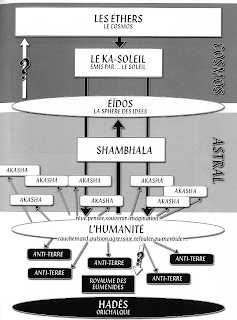
A map of the French cosmology

Image
I neglected to post it in any of my prior posts touching on the French cosmology, but below are some maps of the cosmology taken from the French books. These should give a useful picture of how the cosmology works. Circa Nephilim: Revelation Circa Nephilim IV The cosmology was originally codified some time in second edition and consolidated in third edition ( Nephilim: Revelation ). It hasn't changed significantly since to my knowledge. The Summoning Worlds of the French version aren't include in the above maps. They form their own category separate but adjacent to the Astral. By contrast, the US version never had a chance to develop its cosmology. The most we get is that there's an Astral Plane where summoned beings come from and dreams may be entered from, known as Yetzirah to Summoners and Uat to the High Priestess. There's also the Subtle Planes of Agartha aka the Akasha, but their relationship to the Summoning Worlds (of which the Astral is one) is never explained....

A recap of the Selenim rules introduced in 3e

While the Selenim were given rules in the first and second editions of the French version, these were wishy-washy and the original creative leads preferred them as NPC-only (which once again became the case in 4e and 5e, much to my chagrin). In third edition Nephilim: Revelation , the publisher opted to revise their rules for playability and compatibility with mixed groups of Nephilim and Ar-Kaïm. Additional rules were provided in their respective Codex . I recap the overarching structure of the 3e revisions here. I have divided this post into Initiation, Aspect, Sapience, Past, Downfalls, and Other details, mimicking the structure of character creation. Initiation Unlike the Nephilim's Pentacle of the five Elemental Ka, Selenim have only a Core of Black Moon-Ka. Thus, they can only perform their own Occult Sciences (see below). Additionally, they have a Black Moon Pool that is spend to cast spells. They suffer a degeneration known as Entropy : the Pool automatically loses 1 point...

Khaiban Arcane Techniques

I recently transcribed and auto-translated the rules for playing Khaibans from the third edition French supplement Le Codex des Nephilim . In this post, I would like to compare and contrast that with the Devil's Arcane Techniques given in the US version's Major Arcana . As I noted previously , Khaiba works different in the French and US versions. In the US version Khaiba total just affects how likely the Nephilim is to suffer a Khaiba episode during certain enthronements (but Khaiba total doesn't affect the Metamorphosis ratings), is decreased relatively easily, and won't kill the PC if it reaches 100. Whereas in the French version the effects are persistent, while Khaiba total determines how deformed the Nephilim is, how warped their emotional state is, and kills the PC when it maxes out. One bit I find interesting is in how the Metamorphosis changes between the two versions. In the US version, a Khaiba seizure raises all Metamorphosis traits to max and then warps it i...

Dark Watchtowers of the Black Moon?

As I previously mentioned, the French version gave each occult science five paths . Five mazes of Sorcery, five worlds of Summoning, and five materials of Alchemy, each preferred by Nephilim of one of the five elements. For purposes of organization, I label these the "watchtowers" of the elements. To recap: Element Sorcery Kabbalah Alchemy 🜂 Fire The Axial Way of the Wandering Principles : Fight the darkness and learn from the struggle Aresh, World of Conflict , where the world is in a constant state of war and honor and atrocity are the only lords Metal , mastered by the Green Lion, is Mastery 🜄 Water The Primal Way of the Rising Spiral : Change yourself to change the world. Zakaï, World of Purity , where the world is dying and the only hope rests on the healing of the Fisher King Liquor , mastered by Esmeralda, is Transformation 🜃 Earth The Natural Way of the Winding Pa...